
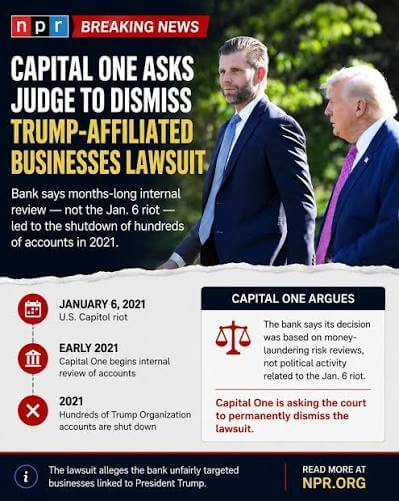
In news item that went fairly unnoticed, the financial company Capital One said in a July 31, 2026 court filing (pdf) that in 2021 it closed hundreds of bank accounts tied to Donald Trump and his businesses for “anti-money laundering reasons.” Four years after closing the accounts, the Trump Organization and Eric Trump sued Capital One alleging the company closed its accounts in bad faith, illegally “debanking” them for political reasons after the January 6 insurrection.
Capital One’s court filing was a motion asking the Court to dismiss the Trumps’ lawsuit as baseless.
Capital One says politics had no bearing on its decision to close the Trump family’s business accounts. The company says its anti-money-laundering team performed “months of analysis” and “careful review” of the Trump-linked accounts before closing them, and they found the financial activity in the accounts showed “characteristics that triggered a review by their anti-money laundering team.” Capital One said it maintained complete confidentiality about the closures and “never publicized the termination decision nor its confidential internal process giving rise to the closure.” It said its “decision to close Plaintiffs’ accounts only became public because of “Plaintiffs’ own decision to pursue this litigation.” Capital One further pointed out that the terms of the contract for the accounts gave both parties the option to terminate their business relationships for any reason.
Capital One did not accuse Trump or his businesses of committing any crimes, and gave the Trumps several months — even granting them several extensions — to obtain new banking services elsewhere before finalizing closure of their accounts.
Capital One was likely motivated to be extra-careful about flagging its accounts for signs of money laundering at the time, because in January, 2021 the U.S. Treasury’s Financial Crimes Enforcement Network (FINCEN) fined Capital One $390 million for “willfully failing to implement and maintain an effective Anti-Money Laundering (AML) program to guard against money laundering.”
The federal Bank Secrecy Act of 1970 requires banks and financial institutions to keep records of, and report any activity that could be linked to money laundering. FINCEN wrote at the time in a press release about the fine that, “Capital One’s egregious failures allowed known criminals to use and abuse our nation’s financial system unchecked, fostering criminal activity and allowing it to continue and flourish at the expense of victims and other citizens.”
The Bank Secrecy Act requires banks to monitor accounts for fraud, suspicious activity, money laundering, tax evasion and other illegal activities.
Activities that can trigger review of bank accounts for money laundering include:
- Sudden, large cash deposits,
- Transactions that appear structured to stay below legal limits, like multiple transactions just under $10,000,
- Frequent wire transfers to high-risk countries,
- Accounts dormant for a long time that suddenly see high-volume use,
- New third parties suddenly using accounts,
- Funds enter an account and then leave it right away, an activity commonly linked to moving “dirty money” in an attempt to hide where it came from,
- Transactions that don’t seem to have a real business purpose, for example that don’t match the type of company that holds the account, and
- Funds that jump from bank to bank
The Trump Organization is no stranger to committing fraud. In December, 2022, it was convicted of 17 counts of tax fraud after a jury found it guilty of shoveling perks to its executives off-the-books, giving them items of value on which they paid no tax, like leased luxury vehicles, luxury apartments, extra cash at holidays and free cable TV and private school tuition for their children. Trump himself has been convicted of 34 felony counts of persistent business fraud. At the time, the judge in that case, Judge Arthur Engoron, said Trump and his associates’s refusal to admit any wrongdoing in the case suggested that their fraudulent activities would continue if not constrained.b
Judge Engoron added that, “Their complete lack of contrition and remorse borders on pathological.”
Sometimes, Capitalism has to draw the line at the crimes of the Trump-Epstein money laundering and child sex trafficking family. The GOP and the DOJ certainly don’t care.