
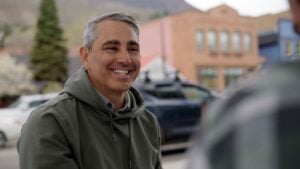
On February 2, 2026, I got the opportunity to sit down for an hour interview with Alex Kelloff, the only Democratic candidate running to unseat CD-3 House Rep. Jeff Hurd. So far Mr. Kelloff is unopposed in the Democratic primary.
Before the interview, I asked my Facebook friends what questions they would like to ask Mr. Kelloff, and got about 50 comments back on the post. I distilled the questions down to about a dozen to accommodate the time allotted for the interview. Below are the results. The conversation has been lightly edited to make our spoken conversation more easily readable in a written format. I’m also including some of Mr. Kelloff’s Instagram posts, so people can get to know him better.
Here are the questions, and Mr. Kelloff’s responses:
Q #1: What are your ideas for how the country can dig out of the huge federal deficit?
A: I appreciate that, because most people don’t ask me about the debt and deficit.
I think it’s two-fold. One, we do have to control spending. It’s common knowledge that our entitlement spending is growing at an unsustainable rate, but probably even more so is the interest on our debt. As the debt balance grows, it is becoming unsustainable. We have to get that under control. I think we have to control spending and we have to grow the tax base. So if I were elected to Congress, I have some specific thoughts on reforming the tax code that would actually drive tax revenue. Some of that has to do with ensuring that people are paying their fair share, but I also think it has more to do with closing tax loopholes that both companies and individuals are able to take advantage of to their benefit. So I think it’s a two-fold problem. We have to grow the tax base, but we also have to control spending.
View this post on Instagram
Q #2: How will you win the votes of rational Republicans, the non-MAGAts?

A: I’m very fortunate that my family roots in this district go back over 130 years in Colorado. My great grandfather and his three brothers immigrated to dig coal, like many immigrants, in the 1890s. They settled in Trinidad, Colorado, and after digging coal, they went on and my family almost exclusively became small business owners in eastern Colorado and some on the western slope. They really had traditional conservative values in these more rural areas of Colorado, and my family was well known and well liked. They were good pillars of the community. My grandfather started a chain of grocery stores called Kelloff’s Food Markets in 1933, during the Great Depression, and I’ll give you an anecdote: I met with an 85 year old Republican in Alamosa a few weeks ago. He said, “I’ve been a lifelong Republican,” and I said, “Well, as a Democrat and I hope I can earn your vote.” He looked at me and said, “I’ve never voted for a Democrat, but it would be hard for me to vote against a Kelloff.” So I’m fortunate that some of that will help in southern Colorado where we can convert some non-MAGA Republicans. But I think it’s also that we need to reach across the aisle and work towards the common good. Cost of living affects everyone. Public lands and water affects everyone in this district. These are non-partisan issues, so we need to work together to solve these issues, and that’s what I’m here to do.
Q #3: How can Democrats increase people’s confidence that the party has real plans for helping people? Are there certain plans that you prioritize?
A: In running in a district like CD-3, I’ve very much come to appreciate that there are many similarities and many of the same issues across rural America, like cost of living and health care — and all of them are important across all districts across the U.S. — I think we also have some unique issues in rural communities that we need to ensure we’re fighting for in this district, like rural health care. We have real issues, where when you get sick or need emergency care, hospitals for many people in the District are a long drive away. And with Medicaid in particular being defunded through the One Big Beautiful Bill that Jeff Hurd voted for, it puts our rural hospitals at risk. If they shut down — which some likely will — then it becomes a life or death situation for many people if they have to drive more than two hours to get to the hospital. So I think more about the issues that affect constituents in the District rather than Democrats writ large at the national level. So I’m very much focused on those things that affect us in these rural areas. But I think there’s a lot of common ground also in addressing cost of living and assuring that people have good jobs.
Q #4: What are your ideas for dealing with the loss of healthcare coverage that so many people have experienced under the Big Ugly Bill?
A: I mean, it’s pretty clear that immediately upon re-taking Congress, we have to reinstate the coverage that’s been lost. Issues have arisen with the ACA (Affordable Care Act) and we have to fix those issues, like making it more efficient. I mean, clearly the health care system in this country is very inefficient and expensive, so there are probably actions we can take to fix those issues, but we have to immediately reinstate the care that was lost.
View this post on Instagram
Q #5: What are your ideas to help unite people in our district in the face of Trump’s effort to divide the country?
A: We have to work across the aisle where there’s mutual interest and I think the encouraging thing about this district is that we all share some common interests. I think we all care about our public lands, and we all see how important water is in our district. We shouldn’t be shipping that off to the Front Range or anywhere else. I think those are bipartisan, and non-partisan issues. I think the cost of living affects everyone. I think small business owners struggle, no matter your political affiliation. So I think there’s a lot of common ground. I think we have to reach across the aisle and work towards common sense solutions that work for everyone.
Q #6: What ideas do you have to overthrow this insidious Stephen Miller regime?
A: We have to hold everyone accountable who’s been unlawful and breaking the law. One concern I have is that as president, Trump has the pardon power, and I worry that he’s going to preemptively grant blanket pardons to everyone in his administration. The good thing is that that doesn’t affect state law, so we need to ensure that we’re documenting all the wrongdoing and unlawful actions by Steven Miller, Russell Vought others, so we hold them accountable when we have the power in Congress, but also when this administration is over in 2028. So I think we need to keep a careful record right now.
Q #7: Do you have any ideas on how to constrain AI, especially in relation to its massive water usage for cooling, which is a particular concern for the western slope of Colorado?
A: On that second part of the question regarding water, you can cool the computer servers ambiently with with air, so [data centers would be more appropriate] in places like in Northern Canada are Scandinavia, where you can get electricity from things like geothermal power, but you actually don’t need that much water to cool the servers because of the ambient air. I don’t believe – and I’ve been involved in data centers in my career – I don’t believe that the 3rd Congressional District is a geography where data centers make any sense whatsoever. So I think we need to be more strategic about where data centers are built, and build them in places where they can consume much, much less water, maybe none at all, and where there’s more abundant electricity, and hopefully cleaner electricity.
I think constraining AI is a tough question, but I am certainly not in favor of the direction this administration has taken where AI is essentially unfettered, with no regulatory guardrails, kind of letting Elon Musk and Mark Zuckerberg do whatever they want with respect to AI. I think it is a national security imperative, but I also think we have to engage with our near-pure adversaries like China to make sure AI is developed responsibly and safely. And we’re just not doing that in this administration.
View this post on Instagram
Q #8: In the face of Trump recently ordering the EPA to cease regulating greenhouse gases and his invalidation of the Endangerment Finding, what can Congress do to reinstate science-based regulatory authority?
A: We need to take Congress back first. And we need to pass laws that enshrine clear [environmental guidance] into law. I mean, I don’t know that much about the repeal of the Endangerment Finding. Part of the legal argument, I believe, was that the EPA overstepped their powers from what the laws say, that Congress has passed. I don’t know if that’s true or not. That’s certainly their legal argument. I think the way we can rectify that [problem] is to enshrine [the Endangerment Dinding] into law so you don’t have to make that argument. I think we need to do that. I think we need clear laws to support the endangerment finding and that are all science-based. And you see this not just at the EPA with respect to climate, but you see that at NIH [National Institutes of Health], where my dad has worked for almost 60 years. We’ve got RFK Junior running rampant to repeal vaccines or what have you. So we need to re-center policies in this country where they depend on science, and make sure they are based on science. And we need to fund those initiatives as well. So research and development needs to be adequately funded. We need to do critical science and get back to doing that.
Q #9: Do you support states’ rights for technology regulation? The person who submitted this question said, “I believe labeling AI material is important,” and in that vein, do you support social media regulations? So the question is, do you support states’ rights for technology regulation and regulation on social media?
A: That’s a tough one.
On one hand, you could say states should have the right. States have many rights over the federal government. On the other hand, it is difficult to compete with countries like China, that have more of a monolithic national policy. If we had 50 different policies in this country I think it could be difficult to advance technology. Having said that, I think the solution is maybe you have Federal Regulations but the administration also works with the states as to what that policy is, and then you have inherent in the laws you’re going to pass that they get reviewed every 2 years or 5 years, to ensure that the national policy is capturing the will of the states as well.
Q: So you believe a national policy is preferable for technology regulation?
A: Yes I think I do.
Q: As opposed to 50 state policies?
A: That’s right. But you have to incorporate in that federal policy the states’ will, and their concerns, because they have valid concerns. I think an analogy there would be like auto manufacturers have to abide by certain federal regulations, but states can set what the speed limit is on their own roads, so I think there needs to be a happy medium, a happy balance there.
Q: But states can also set their own stricter emissions standards, for example, so there can be up to 50 different emissions standards…
A: True. I’m not totally opposed to states being able to set their own laws about technology, but there has to be a balance there. Was there another part of that question, then?
Q: Yes, about social media regulation…
A: I 100% believe that social media needs to be regulated. I think it will be proven harmful just like tobacco was proven to be harmful, and tobacco companies knew that. The same will happen with social media. Social media companies will be held liable and will require some regulation.
Q #10: How will you work to re-establish collaboration with fellow members of Congress?
A: We have to be able to work with those who don’t share the same ideas we have. I’m hopeful there are some reasonable members of Congress on the right who want to work for the good of the country. Recently, you’ve started seeing many start to speak out against Trump. My true belief is that once we control the House, and hopefully the Senate as well, you’re going to see a lot more people flip and want to work together towards a common cause. The example of this I would give is, look at the bipartisan legislation that happened under Biden. You have the CHIPs [and Science] Act passed, the Infrastructure [and Jobs] Act passed. So I’m hopeful there. But we need to control Congress and be the ones holding the levers of power to get those reasonable Republicans back on the right side, working for the American people.
Q: So you think the Republicans would be more willing to flip once the Dems are in?
A: Yes, I do, I think they’d be less afraid of this administration, which can obviously be vengeful. And it will give them cover to say, “Look, Mr. President, the Democrats are in control, so if we want to get anything done, we have to work with them.” And I also think that because now Trump is a lame duck, you’re not going to have what we had, say, when there was the bipartisan agreement on the largest immigration reform bill in decades if not ever, under Biden, and Trump told his lackeys “Don’t vote for that.” So it all fell apart. You won’t have that because Trump’s a lame duck president.
Q: So without that kind of pressure, Republicans might do the right thing?
A: Right.
Q #11: Do you still want to funnel money from ICE to the police?
A: Well I’m not in favor of abolishing ICE. If people know the history of ICE, it came out of the aftermath of September 11. ICE was created upon the creation of the Department of Homeland Security in 2003. But its predecessor was the Immigration and Naturalization Service (INS) that was created in 1933. So we’ve always had immigration and naturalization services. The problem is that after ICE was created in 2003, like many things, different administrations got in and it was mission creep. The mission of ICE has expanded and it’s gotten more funding over time, and now we have what we have today. I think we need to take it back to its original mission, and I think part of that is de-funding the dollars that have gone into that mission creep, and I believe some of that funding should be diverted to local law enforcement.
Q: So you think that ICE should go back to being the more helpful kind of agency that Immigration and Naturalization Services was, helping people to legally immigrate to this country rather than seizing, detaining and deporting them?

A: I’m not sure ….We need to make investments in the immigration system so that there’s a pathway to citizenship, the courts aren’t clogged up and there’s transparency so if you come to this country legally, you can understand how to establish citizenship if you meet the requirements, and on a reasonable timeline. It’s just a chaotic system now. And so we need to invest in the infrastructure of [immigration] judges, the court system and how to be clear rather than [perpetuate] the chaotic process we have now, which is what this administration wants. They want it to be chaotic, and there’s a reason why they want it to be chaotic: They don’t want it to be easy.
Q: I hadn’t heard of this bill, but one person I wanted to know where you stand on HR5785, the Voluntary Grazing Permit Retirement Act. Have you heard of it?
A: No, I’m not familiar with it…
Q: I looked it up. Under the Act, ranchers operating on public lands can choose to permanently waive their federal grazing permits in exchange for “equitable compensation” from private parties, and then federal agencies can retire those allotments from further grazing, ensuring lasting benefits for wilderness, wildlife, and millions of people who depend on healthy public lands.
A: From what you just read, that sounds reasonable, but I’m not familiar with that specific act. What I would say is that I am hugely supportive of our public lands and protecting our water, and I think much like we talked about data centers and AI infrastructure, they don’t have a place in this district because of the abundant public lands that make this place special. I mean, we’re a unique place in all of America with respect to our public lands and our water, so I’m in favor of anything that protects our public lands and water. And I think we need to be smart about how we do that. That’s not to say that we get rid of our natural resource industries, but we need to be smart about how we go about protecting our public lands, and frankly our agriculture industry, ranchers and farmers, who make their livelihood in this district.
Q: Sounds good. Thanks for the chat. Do you have anything else you’d like to add to any of those questions?
A: Two things in particular. We talked about public lands and water. I’m very focused on small business formation and job creation. We don’t have a lot of large employers. Some here in Grand Junction, some in Pueblo, but the backbone of our economy in this district are small businesses, and so I’m very focused on helping facilitate creating small businesses, which lead to good jobs. I also think there’s a lot of infrastructure investment we need to make, that hasn’t been made over many, many decades, so when we talk about water, that’s ensuring our reservoirs and dams are sound, our tunnels that carry water out across our district are sounds, our roads and bridges, we need to ensure those are sound, and in telecommunications, my industry, we need to ensure that rural areas have access to affordable broadband, and more affordable housing. So I’m very much focused on business formation, job creation, and I think that will lead to lower cost of living for all of us. And then finally, it goes without saying, I support the rule of law, and I’m running in part to ensure that Congress returns to fulfilling its obligation as a co-equal branch of government.
Q: Great, thank you, that wraps it up thanks for your time today.
View this post on Instagram
Kelloff did a good job dancing around the grazing questions. It’s a KOD in the 3rd CD.
Whatever that means. Please attempt to make sense.
I just had a phone convo with Alex, and we primarily discussed one issue, the one I see as being most important here:
Colorado Republicans are about to learn that Gerrymandering is a 2 player game!
CHANGE THOSE MAPS!!!
Thank you Anne!
Please forward these questions to Mr. Keloff
Question #1; How are you going to make an effort to get big money out of politics? That is the underpinning of many of these issues. That is why our Representatives vote against their constituents, they get money from big donors like AIPAC and Silicon Valley Bros. and are beholding to their interests over public interests. Congress has not voted with public opinion for a very long time.
This is how we got Trump; rage voters.
Question #2 Are you going to take money from big donors? Majority of party affiliations do!
I won’t vote for a party that will bankroll genocide, what is your view on that?
Try sending these questions to him at alex@alexkelloff.com
Great timing for this interview with Candidate Alex Keloff.
( following Trump’s un-endorsement of Rep. Jeff Hurd.