
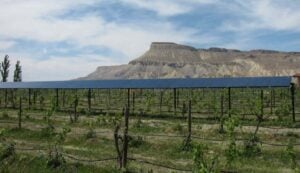
The local nonprofit group Western Colorado Alliance (WCA) has been following Mesa County’s development of an updated Land Use Code (LDC) and is sounding the alarm. The Mesa County Commissioners have proposed a discriminatory — and some say prohibitive — 1/4-mile setback requirement for solar farms, far bigger than the County requires for more disruptive land uses, like drilling for fossil fuels, mining that uses crushers or similar equipment (like gravel pits, for example) or mines that require larger-scale excavation.
The LDC is the rulebook that governs activities like land use, zoning and residential and commercial construction in unincorporated areas of the county.

Local solar advocates say the County’s huge proposed 1,320-foot (1/4 mile) setback discriminates against solar farms and agrivoltaics (the simultaneous use of land for solar power and agriculture) while giving preferential treatment to more extractive, intensive and destructive land uses. It also significantly reduces the amount of land available for community solar gardens compared to other industrial uses in the county.
Citizens are getting increasingly worried over the direction Grand Junction City Council and the Mesa County Commissioners have been taking recently in regard to other changes they’ve made to development rules.
For example, the current draft of the County’s new LDC would make some open-space requirements optional instead of mandatory, require the county to post public notices about new developments only on the county’s website instead of in newspapers, allow some residential construction in commercial zones, and increasing residential density in some zones, all on top of the new setback requirements for industrial land uses, particularly solar farms.

Another worrisome example suggests developers may have captured the city and county development departments. After pressure from real estate developers, on September 2, 2026, the Grand Junction City Council voted 4 – 3 to repeal Ordinance 5340, which previously blocked developers from chopping down significant, mature trees to make room for their new developments (Ordinance No. 5340). Last summer the City also made another change that reduced the amount of outdoor bike parking most businesses must provide based on their square footage, and roughly cut in half the required bike rack availability for most apartment complexes. Furthermore, the City did away with long-term secure bicycle storage requirements for multi-family residences. Housing advocates argue that people who rely on bicycles for transportation and live in affordable, multi-family housing need secure bicycle storage on site so they do not have to store bikes inside their apartments.
Critics are arguing that the County’s stance on setbacks for solar arrays amounts to picking winners and losers in the energy sector. WCA also points out that the County mistakenly justified its new setback requirements based on faulty information. An Open Records Act request showed that Planning Commission Chair Clifton Ansen claimed solar projects were responsible for lowering the value of a Mesa County property and that the 1/4 mile setback was needed to protect property values. However the Mesa County Assessor’s Office verified that the value of the property in question dropped mainly because of its topography, not because of the view of the solar farm.
WCA is a local nonprofit group that works on issues like climate change, energy, homegrown prosperity, housing affordability and grassroots democracy.
This is the last week for people to submit comments and suggestions on the updates to Mesa County’s Land Development code. On November 17, the county commissioners will vote on adopting the proposed changes. That meeting will take place at 1:30 p.m. in the Public Hearing room in the Old Courthouse, 544 Rood Avenue in Grand Junction. Anyone can review the proposed changes to the Mesa County LDC and share their input by emailing mccomdev@mesacounty.us as part of the public process. To make comments to the Grand Junction City Council, email council@gjcity.org or call the G.J. City Comment Line at 970-244-1504.